

Mountain bike rental in Santa Teresa makes sense when you want the ride itself to be part of the day. A conventional hardtail can handle many unpaved public roads better than a beach cruiser and gives confident cyclists a simple way to explore without fuel or a motor. It does not automatically make every hill, trail or muddy road suitable.
Santa Teresa is hot, elongated and uneven. The main corridor carries mixed traffic, while side roads can climb sharply and change between loose dust, embedded rock, ruts and wet mud. A route that looks short on a map can become a demanding workout. Choose the bike, time and route together—and arrange repair support before leaving.
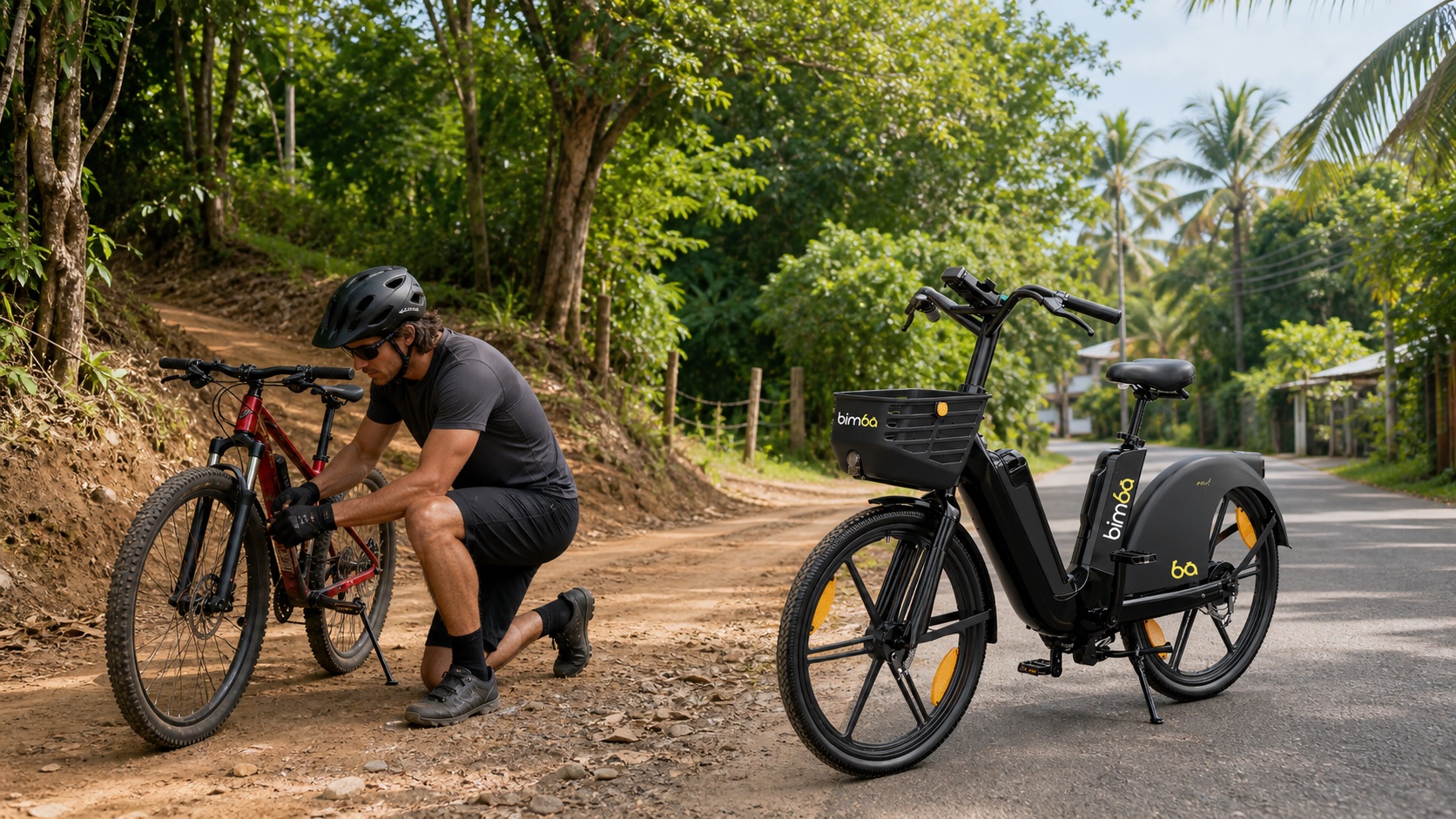
Bimba operates shared electric vehicles locally, so we have a commercial interest in bicycle transport. A Bimba e-bike can suit some short assisted trips, but a conventional mountain bike is the more honest choice when you want exercise, all-day possession or a guided ride beyond the shared network. This guide explains both sides.
Is a Mountain Bike a Good Way to Explore Santa Teresa?
Yes—for a rider who already feels comfortable with gears, braking and loose surfaces, a mountain bike can be a rewarding way to explore public roads around Santa Teresa. Wide tires, low gears and front suspension are useful on rougher surfaces. You still need realistic expectations: this is not a protected bike park, and ordinary roads may carry cars, motorcycles, ATVs, pedestrians, dogs and delivery vehicles.
A mountain bike is less suitable when the bicycle is only a way to reach dinner without effort. Heat and hills can turn the return into the hardest part of the day. It is also a poor choice for riding after dark, carrying suitcases, transporting a surfboard without a purpose-built rack, or learning off-road technique for the first time.
Decide whether your intent is recreation or transport. Recreational riders should choose a known public route, start early and consider a guide. Transport riders should compare a conventional bike with an e-bike, taxi, ATV or car based on the real daily journeys. Our Santa Teresa transport guide helps with that wider decision.
What Does Mountain Bike Rental Cost in Santa Teresa?
One local operator, ATValerios, currently publishes a mountain-bike rate of US$20 plus tax for 24 hours and US$120 plus tax for seven days. Its listing says the bikes include multiple gears, front suspension and a combination cable lock. It also states that bike delivery, hotel pickup and surfboard racks are not offered.
The same operator currently publishes a US$250–300 credit-card guarantee deposit for a bike and requests original identification and a physical driver's licence under its rental requirements. Those terms belong to that operator, not to every rental business. They are useful because they show why the headline daily price is only the beginning of a comparison.
Prices and conditions can change by season, inventory and rental length. Verify the current total directly on the ATValerios rental page before walking across town. Ask whether tax, lock, helmet, repair kit, damage cover, delivery and roadside recovery are included. Never copy an old rate into the budget without confirming the date.
| Cost or term | Published local example | What to verify |
|---|---|---|
| 24-hour mountain-bike rental | US$20 + tax | Current model, size, helmet and pickup time |
| Seven-day rental | US$120 + tax | Maintenance support and early-return terms |
| Guarantee deposit | US$250–300 by credit card | Release timing and damage deductions |
| Delivery / hotel pickup | Not offered in the cited listing | Where you must collect and return |
| Surfboard rack | Not offered in the cited listing | Do not assume a board can be carried safely |
| Guided MTB tour | Quote required | Bike, guide, water, route and support included |
Rental Price Is Not the Complete Cost
A low daily rate can still be poor value if the bike does not fit, the shop is far from your accommodation or a puncture leaves you paying for a taxi back. Compare the complete rental: tax, deposit, payment fee, protective equipment, tool kit, delivery, recovery and the number of hours you will actually ride.
Ask how damage is assessed. Normal dust is not the same as a bent wheel or damaged derailleur, but the agreement determines liability. Photograph both sides of the bicycle, rims, derailleur and existing frame marks with the provider present. Keep a copy of the signed terms and the return time.
For several days, calculate the cost per realistic use rather than dividing the weekly price by seven. If you expect only two morning rides and need taxis for rain or dinner, two daily rentals may be simpler. If cycling is central to the holiday, a maintained weekly bike with reliable support may be worth more than the cheapest option.
Choose the Right Mountain Bike, Not Just Any Bike
Most visitors need a well-maintained hardtail: front suspension, useful low gears and tires suited to mixed dirt and road riding. Full suspension can help on genuinely technical terrain, but it adds complexity and is unnecessary for ordinary public-road exploration. A cruiser may be comfortable on a short flat trip but lacks the gearing and control many hills demand.
Fit comes first. With a pedal at its lowest point, your knee should remain slightly bent rather than locked. You should be able to reach both brake levers without stretching, and the saddle should not force your hips to rock. Ask for another size if the cockpit feels cramped or the frame prevents safe mounting.
Wheel size and component names matter less than function. A 29-inch bike can roll smoothly over rough surfaces, but only if the frame fits. Hydraulic disc brakes offer strong control, yet neglected pads or a soft lever remain a problem. Do not accept “mountain bike” as proof that every part is ready.
Inspect the Rental Before You Ride
Spend five minutes checking the bike in daylight. Costa Rica's official tourism guidance recommends inspecting the chain, gears, tire pressure, brakes and brake pads before a mountain-bike ride and carrying a tool kit. That is sound advice anywhere; in Santa Teresa, it also prevents a small shop-side problem from becoming a roadside one.
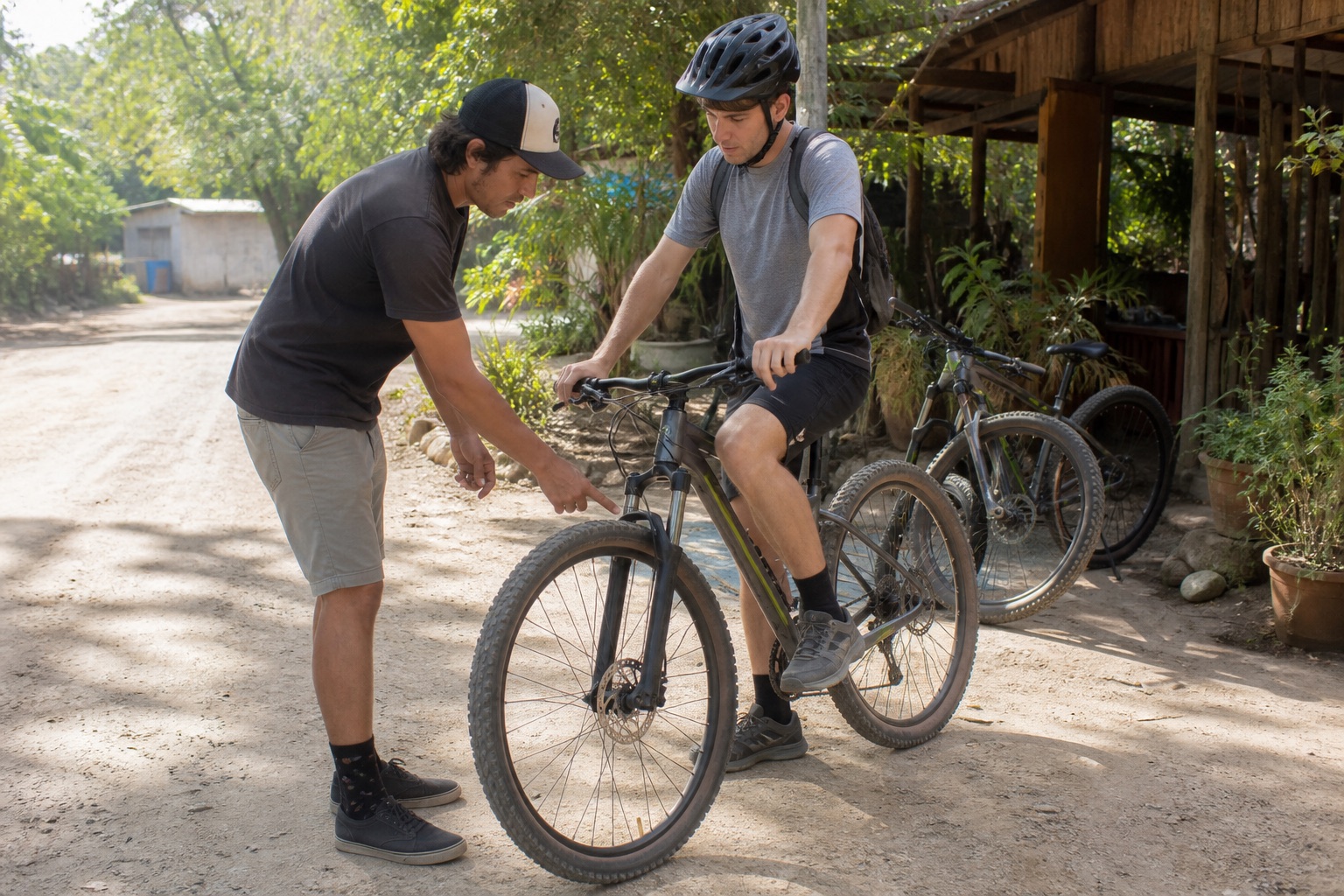
Roll the bike and squeeze each brake separately. The lever should not touch the handlebar, and the wheel should stop without violent grabbing. Look for cuts, exposed casing, loose spokes and side-to-side wheel movement. Shift through the gears under light pedal pressure and listen for repeated skipping.
Check that the quick-release levers or thru-axles are secure, the handlebar is aligned and the seatpost clamp holds your height. Fit the helmet so it sits level and does not slide when you shake your head. Finally, ask the provider to show you the lock, pump or tube and explain exactly whom to contact after a mechanical problem.
| Part | Quick check | Reject or fix before leaving when… |
|---|---|---|
| Front and rear brakes | Test separately at walking speed | A lever reaches the grip or braking is weak |
| Tires and wheels | Check pressure, tread, cuts and side movement | Casing shows, rim wobbles or tire is soft |
| Gears and chain | Shift through the range under light load | Chain skips, drops or derailleur contacts spokes |
| Suspension | Compress fork and inspect stanchions | Fork sticks, leaks heavily or has unusual play |
| Fit | Set saddle and test reach | You cannot control the bike comfortably |
| Helmet | Level position and secure strap | It is cracked, oversized or cannot be adjusted |
| Support | Save contact and recovery policy | Provider cannot explain what happens after a failure |
Mountain Bike Routes and Guided Tours
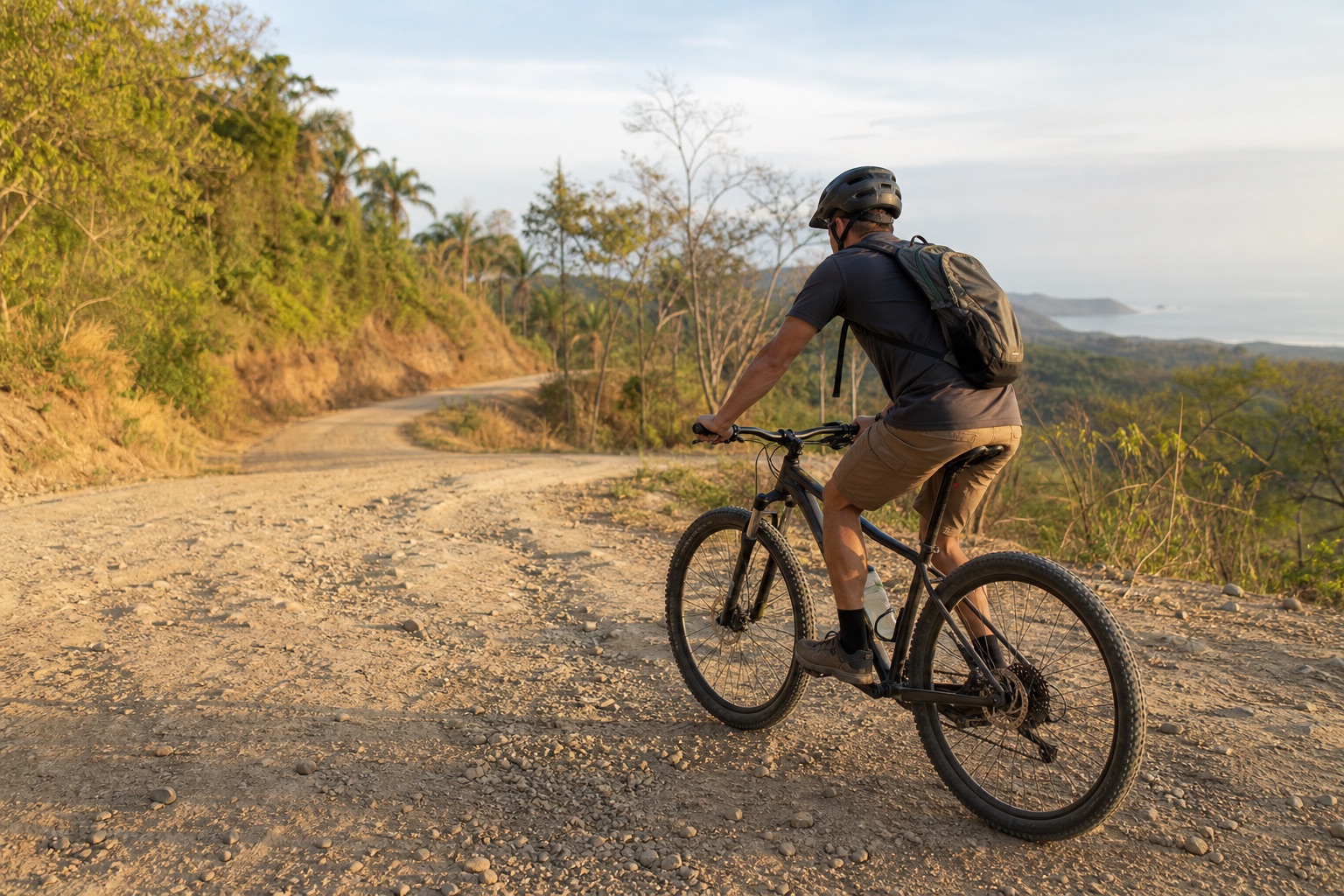
Do not assume every visible path is a public mountain-bike trail. Land boundaries and permitted access are not always obvious, and conditions can change. Ask the rental provider or a qualified guide for a route that is legal, open and appropriate for your ability on the day. Never enter signed private property or protected areas without explicit permission.
Costa Rica Outdoors & Waves advertises guided mountain-bike routes through the southern Nicoya Peninsula and describes terrain that can include dirt roads, climbs, descents and rural scenery. Its current page lists beginner rides of about 1.5–2 hours, intermediate rides of 2.5–3 hours and expert rides of 3.5–4 hours. It says tours include a hardtail bike, helmet, fruit, water and a bilingual guide.
The operator also lists Scott hardtails with 29-inch wheels, hydraulic disc brakes, front suspension and Shimano components. These specifications illustrate the difference between a casual rental and a purpose-planned tour; they are not a guarantee of what will be available on your date. Review the current details with Costa Rica Outdoors & Waves and request the route, price, group size and cancellation terms directly.
A guided ride is especially valuable for first-time visitors because the guide chooses the route, monitors pace and manages navigation. It does not remove personal responsibility. Tell the operator honestly about recent riding experience, fitness, injuries and comfort with steep or loose descents.
How to Plan a Self-Guided Ride
Build the route from the slowest rider's ability, not the strongest person's ambition. Save the turnaround point and return time before leaving. An out-and-back route is easier to manage than an unfamiliar loop because every kilometer outward must still be ridden home.
Start early. Morning temperatures are generally more comfortable, traffic patterns may be easier to read and you retain daylight for a mechanical problem. Carry more water than a city ride would require, plus sun protection, identification, a charged phone and a small amount of cash. Download the map for offline use but do not assume a digital line represents public access.
Tell someone the route and expected return. If the group splits, stop at the agreed meeting point rather than letting one rider chase another. Turn around for worsening weather, repeated mechanical trouble, an unsuitable crossing or fatigue that compromises braking and balance.
- Confirm the route is public, permitted and currently passable.
- Record distance and elevation—not distance alone.
- Set a turnaround time with daylight margin.
- Carry water, phone, ID, pump, tube or patch kit and tire levers.
- Save the rental provider and backup transport contacts.
- Avoid headphones that block traffic and environmental sounds.
- Plan a shorter first ride before committing to a full day.
Riding Conditions: Dust, Rain, Heat and Traffic
Dry-season roads can develop loose dust, corrugations and hidden pothole edges. Give yourself more braking distance and avoid sudden steering inputs on gravel. Dust from passing vehicles can briefly reduce visibility, so slow down rather than racing through the cloud.
Rain changes the same route. Painted surfaces, roots, rock and compacted mud can become slippery; ruts can fill with water and conceal depth. A mountain bike is not a promise of traction. If the road exceeds your skill or the storm reduces visibility, postpone the ride or choose enclosed transport.
Heat is a performance and safety issue. Drink before you feel depleted, use shade and lower the pace on climbs. The return may coincide with stronger sun even if the ride began comfortably. A rider who is overheated makes slower decisions and can lose braking precision.
On public roads, ride predictably and defensively. Costa Rica's road law requires cyclists to use due care, keep the bicycle in good condition, carry identification and follow applicable road rules; it also states cyclists must not ride on sidewalks. Review the current Spanish text in Costa Rica's Traffic Law No. 9078 rather than relying on a summary when legal detail matters.
What to Do After a Puncture or Mechanical Problem
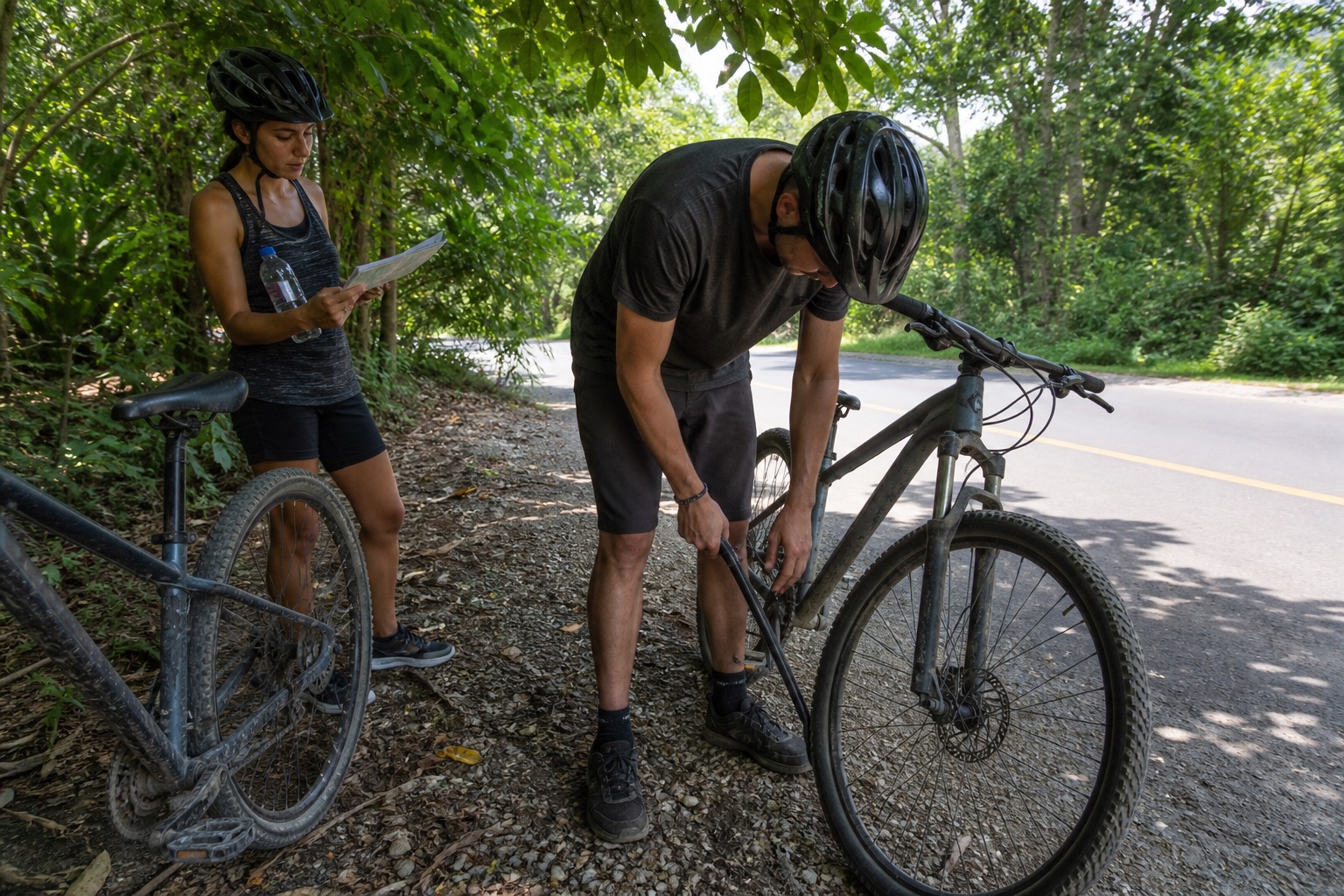
Move fully away from moving traffic before inspecting the bicycle. Do not stop around a blind bend or work with your back exposed to the road. If there is no safe shoulder, walk the bike to a visible area even if that risks the tube; personal safety comes before the wheel.
For a simple puncture, use the provider's agreed procedure. Some shops expect renters to install a tube; others prefer a call to avoid damage. Do not turn the bicycle upside down on sensitive controls without care, and never force a derailleur or brake component you do not understand.
Send the provider your live pin, a clear photo and a short description. Ask whether they will repair, replace or recover the bike and whether the service has a charge. If support is unavailable, use the saved taxi contact. Do not ride a soft tire, cracked rim, loose handlebar or failing brake back to town.
- Get yourself and the bicycle out of traffic.
- Photograph the problem before attempting a repair.
- Follow the rental provider's repair policy.
- Use only tools and repairs you understand.
- Call for recovery when steering, braking or wheel integrity is affected.
- Record any payment and return adjustment in writing.
Can You Carry a Surfboard on a Mountain Bike?
Only with a purpose-built rack approved by the rental provider—and the local rental example cited in this guide specifically says its mountain bikes do not offer surfboard racks. Do not assume you can hold a board under one arm, attach it with improvised cords or balance it across the handlebar.
A board changes wind resistance, width, balance and braking. Traffic, potholes and side gusts make that especially relevant on Santa Teresa's roads. Even a proper rack needs enough clearance from the wheel, pedals and steering and must comply with the provider's rules.
For a surf session, ask a taxi, ATV or suitable rental vehicle about safe board capacity, or choose accommodation and a break close enough to reach without carrying equipment on a bicycle. See our Santa Teresa beach guide before choosing the destination pin.
Mountain Bike vs E-Bike vs Cruiser
These bicycles solve different problems. A conventional mountain bike rewards effort, offers familiar mechanical simplicity and can suit rougher permitted routes. An e-bike reduces effort on an appropriate local trip but adds battery, service-area and availability considerations. A cruiser favors comfort and simplicity on shorter, flatter journeys.
Choose the mountain bike when you want a workout or guided exploration and already have the required control. Choose an e-bike when the journey is suitable but assistance makes repeated local travel more practical. Choose neither for heavy rain, alcohol, luggage, darkness or an access road beyond your ability.
Bimba is the publisher and operates the shared e-bike mentioned here. Live vehicles, pricing, parking and service boundaries belong in the Bimba app. For a neutral decision process, compare our Santa Teresa bicycle rental guide and e-bike versus car guide.
| Question | Mountain bike | Shared e-bike | Cruiser |
|---|---|---|---|
| Best use | Exercise, guided ride, rougher permitted roads | Suitable assisted short trip | Shorter, flatter leisure ride |
| Effort | Fully rider-powered | Motor assistance | Fully rider-powered with fewer low gears |
| Possession | Rental period | Per available app session | Rental period |
| Rough-surface control | Generally strongest of the three | Depends on model and permitted road | Usually most limited |
| Main limitation | Heat, hills and rider fitness | Availability, battery and service rules | Gearing and rough-road capability |
When a Taxi, ATV or Car Is the Better Answer
Choose a taxi when the trip is occasional, after dark, after drinking or involves luggage. Choose a suitable car when a family or group needs repeated transfers, weather protection or longer day trips. An ATV may fit rough permitted roads and hill access when the driver meets rental requirements and uses it responsibly.
Using another vehicle is not a failure to be adventurous. A mountain bike is excellent when its limitations match the plan. It is a bad tool when exhaustion, rain, cargo or darkness removes the safety margin.
For side-by-side comparisons, read the Santa Teresa taxi guide and the ATV rental comparison. Plan the return before selecting the outward vehicle.
Mountain Bike Rental Checklist
- Exact bike model and frame size confirmed.
- Current price, tax, deposit and payment method confirmed.
- Return time, late fee and cancellation terms saved.
- Brakes, tires, wheels, gears, chain and fork checked.
- Helmet fitted and lock demonstrated.
- Repair kit and roadside-support procedure understood.
- Public, permitted route and elevation reviewed.
- Water, phone, ID and daylight margin planned.
- No surfboard or cargo unless an approved system is supplied.
- Backup transport contact saved.
Mountain Bike Rental Santa Teresa FAQ
How much is a mountain bike rental in Santa Teresa?
ATValerios currently publishes US$20 plus tax per 24 hours and US$120 plus tax per week. Treat this as one dated local example and verify the current total and terms directly.
Do mountain-bike rentals include a helmet?
It depends on the provider. A guided-tour listing says a helmet is included, while a standalone rental page should be checked directly. Never leave without a correctly fitted helmet.
Can beginners ride a mountain bike in Santa Teresa?
A beginner comfortable with basic cycling may choose a short easy route or guided beginner ride. Santa Teresa's traffic, loose surfaces and hills are not a good place to learn advanced off-road skills alone.
Are there official mountain-bike trails in Santa Teresa?
Do not assume every dirt path is an authorized trail. Ask a qualified provider for a public, permitted route and current access conditions.
Can I rent a mountain bike with a surfboard rack?
The local rental example cited here explicitly says it does not provide surfboard racks for its bikes. Ask other providers directly, and never improvise unsafe carrying.
Is a mountain bike better than a Bimba e-bike?
A mountain bike is better when exercise or a recreational ride is the goal. A Bimba can be more convenient for a suitable assisted short trip when a vehicle is available. Neither is best for every route.
What happens if I get a puncture?
Move away from traffic, photograph the issue and follow the provider's repair or recovery policy. Save that policy and phone number before leaving the shop.
Should I ride after dark?
Avoid it. Limited visibility, uneven surfaces and mixed traffic increase risk. Plan a daylight return or pre-arrange a taxi.
Final Local Recommendation
Rent a mountain bike when you want to ride—not because it looks like the cheapest universal transport. Start with a properly fitted hardtail, a documented inspection and a route that is public, permitted and shorter than your maximum ability. The best first ride leaves enough energy and daylight to return comfortably.
If the provider cannot explain fit, maintenance, deposit terms and mechanical support, keep looking. If weather or fatigue changes, shorten the route. Good local exploration is not measured by the farthest pin reached; it is measured by whether the bike, rider and road remained compatible for the whole journey.
For current general safety guidance, see Visit Costa Rica's biking guidance. For every live commercial variable—price, inventory, model and route—confirm with the operator close to the ride.