

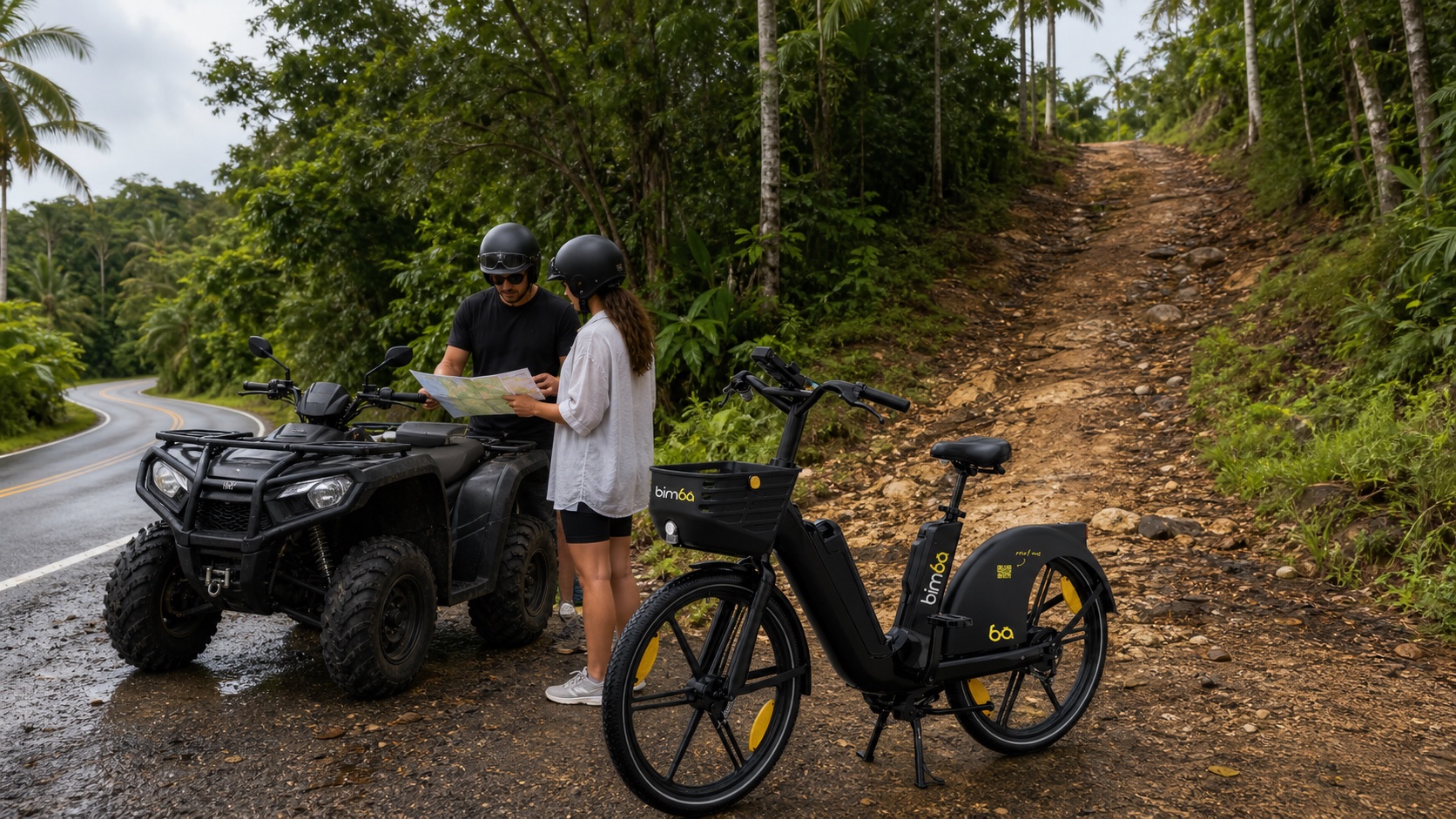
ATV rental is popular in Santa Teresa because a suitable quad can handle some steep, uneven access roads and longer journeys that are wrong for a shared e-bike. That capability comes with a daily contract, licence requirements, fuel, a substantial deposit and real responsibility on a road shared with residents, pedestrians and other vehicles.
Bimba operates the shared e-bike service compared in this guide. We have made the commercial relationship explicit and included the cases where an ATV, car or taxi is clearly the better choice. The goal is not to declare one winner; it is to match the least excessive safe vehicle to the actual route.
Quick Answer: Should You Rent an ATV in Santa Teresa?
Rent an ATV when an experienced, correctly licensed driver needs continuous transport for steep or rough permitted access, regional trips or approved passenger and equipment carrying. Current Santa Teresa listings reviewed August 6, 2026 advertise 250–300cc quads from about US$70 per day and 420–520cc models from about US$80–90 per day. Deposits commonly shown on local fleet pages are around US$500.
Do not rent an ATV only because it looks like the default Santa Teresa vehicle. For short compatible trips in Bimba's active area, US$1 to unlock plus US$0.50 per minute—or a US$15 daily pass with 100 minutes—may be more efficient. For children, luggage, heavy rain or weather protection, an appropriate car or transfer can be the stronger answer.
An ATV is not permission to ride on the beach, enter private tracks or ignore traffic rules. Costa Rica's official tourism safety guidance says four-wheelers must not be ridden on beaches or heavily trafficked roads and advises helmets, appropriate protective clothing and a clear emergency plan.
ATV Rental Prices in Santa Teresa for 2026
The table records public rates visible on local operator pages during our August 6, 2026 review. It is a planning reference, not a guaranteed quote. Tax, season, payment method, rental length, delivery, insurance and equipment can change the final amount.
The cheapest public figure is not automatically the best value. Compare the exact model, engine size, passenger approval, helmet count, tires, insurance, roadside support and deposit. A well-documented US$80 quote can be safer and cheaper than a vague US$70 offer that excludes tax or leaves damage liability undefined.
| Current public example | Advertised rate | Published detail |
|---|---|---|
| Kymco MXU 300 | From US$70/day | Local listings show a 300cc automatic quad |
| Honda TRX 420 | US$80/day | Two helmets and optional surf rack shown by one local fleet |
| Yamaha Kodiak 450 | US$90/day | Automatic 450cc example |
| Honda TRX 520 | US$90/day | Higher-displacement two-seat listing |
| Honda ATV starting price | US$75 cash / $85 card plus tax | Buggy Blue publishes separate cash and card rates |
| Typical public deposit | About US$500 | Shown by several local ATV fleet listings |
Weekly Rates and the Real Daily Average
A weekly label can mean either a total weekly price or a lower per-day rate for a seven-day booking. Read the unit carefully. Motorcycle Rentals Santa Teresa currently shows examples such as US$65 per day on a weekly Kymco MXU 300 booking, US$75 per day for a Honda TRX 420 and US$80 per day for 450–520cc models. Multiply the rate by the booked days and request the final total in writing.
A lower weekly average only saves money if you need the quad for the full period. Add fuel, tax, delivery, parking and days when it remains unused. If the ATV is mainly for two regional days or a difficult arrival road, a shorter rental combined with Bimba and taxis may cost less overall.
Ask whether a 24-hour rental is exactly 24 hours or tied to the operator's opening hours. Confirm late fees, grace periods, early return rules and the charge for pickup after a breakdown.
- Final total for the exact dates and hours.
- Whether tax is included or added.
- Cash and card price difference.
- Daily versus weekly unit and minimum duration.
- Delivery and collection area.
- Fuel, cleaning and late-return policy.
What Is Usually Included—and What May Cost Extra
Several current local listings advertise two helmets, free local delivery and an optional surf rack, but inclusions differ by provider and model. Verify every item instead of transferring terms from one listing to another. A helmet is useful only if it fits, fastens correctly and has no visible damage.
Insurance wording deserves its own explanation. Ask what policy applies, the deductible, what damage is excluded, and the maximum amount you could owe. Tires, wheels, underbody, water damage, theft, keys, unauthorized drivers and use on prohibited roads may be treated differently from collision damage.
A security deposit is normally a temporary card hold, not the daily price. Still, it reduces available credit and may take time to release. Record the amount, currency, card requirement and release procedure before pickup.
| Possible item | Never assume—confirm |
|---|---|
| Helmets | Number, size, condition and replacement availability |
| Surf rack | Price, supported board, installation and straps |
| Delivery | Included zone, time window and collection fee |
| Insurance | Coverage, deductible and exclusions |
| Roadside support | Hours, geographic area and recovery charges |
| Deposit | Amount, payment method and release timing |
Licence, Age and Passenger Rules
An ATV is a motor vehicle, not a bicycle. Confirm that the driver's original licence is valid in Costa Rica and covers the quad's engine category. Costa Rica Traffic Law 9078 distinguishes class-A entitlements by engine capacity; its A1 category includes certain triciclos and cuadraciclos up to 250cc, while larger machines require an appropriate higher entitlement. Foreign licence equivalence and operator acceptance should be confirmed before payment.
Visit Costa Rica states that tourists generally do not need an international driving permit and may drive with a valid legal home-country licence for up to three months. That does not turn a car-only licence into an ATV entitlement. Send the provider the licence class and exact requested engine size and obtain written acceptance.
Operator rules can be stricter than the legal minimum. Ask the minimum age, required experience and whether a passenger is authorized on the exact model. A long seat or two helmets does not prove that two-up use is allowed. Children should never be added without clear legal, contractual and properly fitted protective arrangements.
- Original valid driving licence with appropriate entitlement.
- Passport or accepted identification.
- Credit card for the security hold.
- Minimum driver age and experience requirement.
- Named authorized drivers only.
- Exact passenger count and age rules.
ATV vs Bimba E-Bike vs Motorcycle vs Car
The ATV article owns one specific decision: whether quad capability and continuous rental responsibility fit the route. The motorcycle guide covers powered two-wheel models and licensing, while the complete transport guide compares the whole local system.
Choose the hardest legitimate requirement. A short café trip does not need an ATV's bulk, while a Bimba should not be pushed onto a route outside its active area or beyond the rider's ability. A car can be better than both when weather protection, child seats or secure luggage matter.
| Option | Best fit | Main limitation |
|---|---|---|
| ATV | Experienced licensed driver, suitable rough access, continuous regional use | Daily contract, deposit, fuel, noise, exposure and parking |
| Bimba e-bike | Suitable short local trip with live availability | One rider, service area, weather, route and approved parking |
| Motorcycle | Experienced licensed rider needing range and narrower vehicle | Two-wheel skill, balance, licence and cargo constraints |
| Rental car | Family, luggage, child seats, rain and longer trips | Insurance, fuel, parking and vehicle-class decision |
| Taxi | Occasional ride, night, alcohol, rain or luggage | Requires confirmation; price and availability vary |
When an ATV Is Genuinely the Better Choice
An ATV can be appropriate when the accommodation approach is steep, loose or repeatedly difficult and the host and rental operator confirm the exact model is suitable. Four wheels can offer a different stability profile from a motorcycle, but they do not eliminate rollover, braking or surface risks.
It can also suit an experienced driver making several permitted regional trips and needing continuous access without waiting for a shared vehicle. Passenger and board needs must still match the vehicle and contract. Capability should solve a documented road problem—not create a reason to search for prohibited terrain.
If only one day requires extra capability, price one or two ATV days rather than automatically renting for the full stay. A transfer may be even simpler for arrival luggage on a difficult road.
- Exact access road verified with host and operator.
- Appropriate engine class and driver entitlement.
- Repeated permitted routes outside a shared network.
- Approved passenger or equipment need.
- Secure parking and fuel plan.
- Weather and return conditions remain suitable.
When Bimba Is the Better Choice
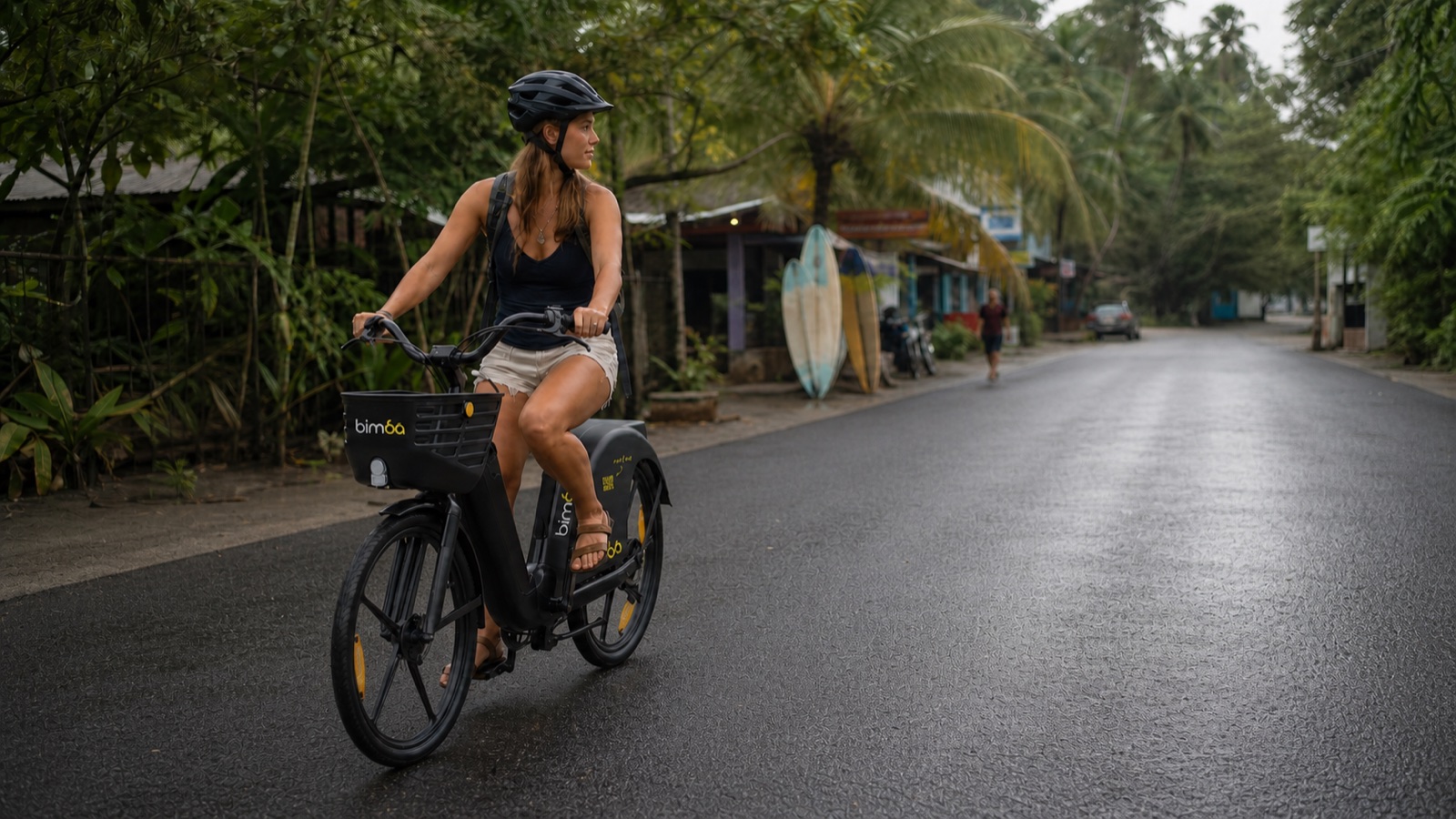
Bimba fits an adult rider making a short journey inside the active service area when a vehicle is available, the weather and road are suitable, and approved parking exists at the destination. Pricing is US$1 to unlock plus US$0.50 per minute. The US$15 daily pass includes 100 minutes and can work well for several compatible local trips.
Bimba avoids a full-day rental contract, fuel and a US$500-style ATV deposit. It also uses less physical road and parking space. Those advantages do not override route suitability, rider confidence or live availability.
Use the app before relying on the trip. A daily pass does not reserve a particular vehicle. Keep a taxi contact for an important return, heavy rain or darkness, and never use a shared e-bike after drinking.
| Illustrative Bimba use | Cost |
|---|---|
| 10-minute trip | $1 unlock + $5 time = $6 |
| 15-minute trip | $1 unlock + $7.50 time = $8.50 |
| Two separate 15-minute trips | $17 total |
| Daily pass | $15 with 100 included minutes |
Inspect the ATV Before Accepting It
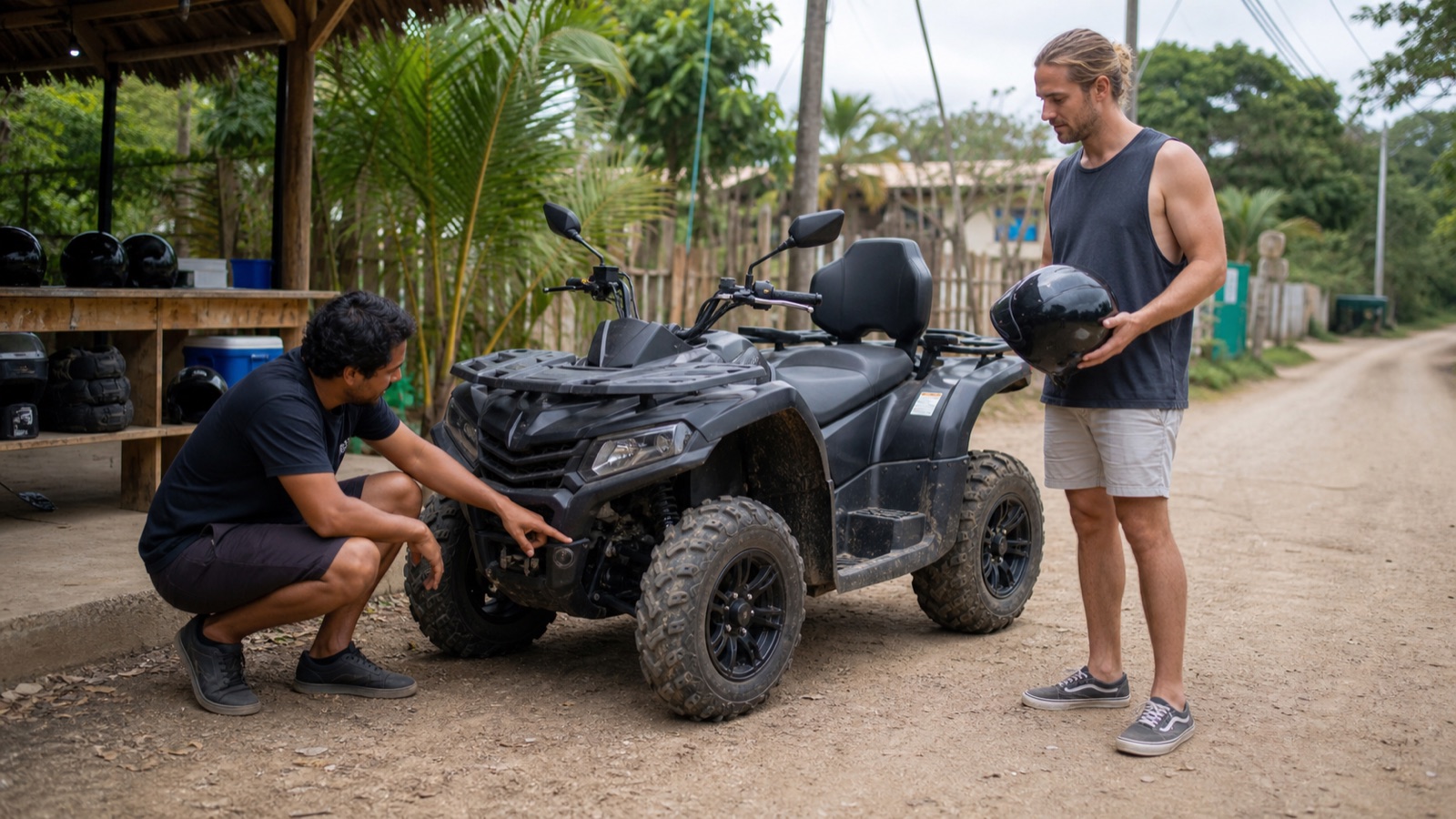
Complete the handover in daylight on level ground. Film one continuous walk-around and photograph every panel, rack, wheel, tire, light, mirror and existing scratch. Ask the provider to acknowledge the record in the contract or message thread.
Test front and rear braking response, steering, throttle return, gear selector, parking brake, horn, headlights, brake lights and indicators. Inspect tire tread and sidewalls and look underneath for leaks or damage without placing yourself under an unsupported vehicle.
Check both helmets for correct size, intact straps and visible damage. Ask for a controls demonstration and practice only in the provider's safe designated area. If the machine behaves unexpectedly, stop and request another vehicle.
| Inspection | What to record |
|---|---|
| Tires and wheels | Tread, pressure, cuts, rims and wheel condition |
| Controls | Throttle return, brakes, selector and parking brake |
| Visibility | Lights, indicators, horn and mirrors |
| Structure | Panels, racks, underbody view and leaks |
| Safety gear | Correctly fitted helmet for each approved rider |
| Documents | Registration, contract, emergency contact and permitted area |
| Evidence | Timestamped pickup video and written damage acknowledgement |
Insurance, Damage and Deposit Questions
Ask the provider to show the coverage and deductible in writing. ‘Insured’ does not explain how much the renter owes, and ‘full coverage’ may still exclude negligent or prohibited use. Identify the maximum exposure after collision, theft, rollover, tire damage or water entry.
Confirm who may drive. Allowing an unnamed friend to take the ATV can invalidate protection. Ask whether roads, beaches, river crossings, private land, nighttime use or particular districts are excluded. Never interpret mechanical ability as contractual permission.
At return, repeat the photo inspection with the provider and obtain a written receipt confirming the vehicle's condition, fuel and return time. Keep it until the deposit hold is released.
- Deductible and maximum renter liability.
- Collision, rollover and theft coverage.
- Tires, wheels, rack, underbody and water exclusions.
- Authorized drivers and passengers.
- Permitted roads and geographic boundary.
- Recovery, towing and lost-key charges.
- Deposit release confirmation.
Road Conditions: Dust, Rain, Hills and Traffic
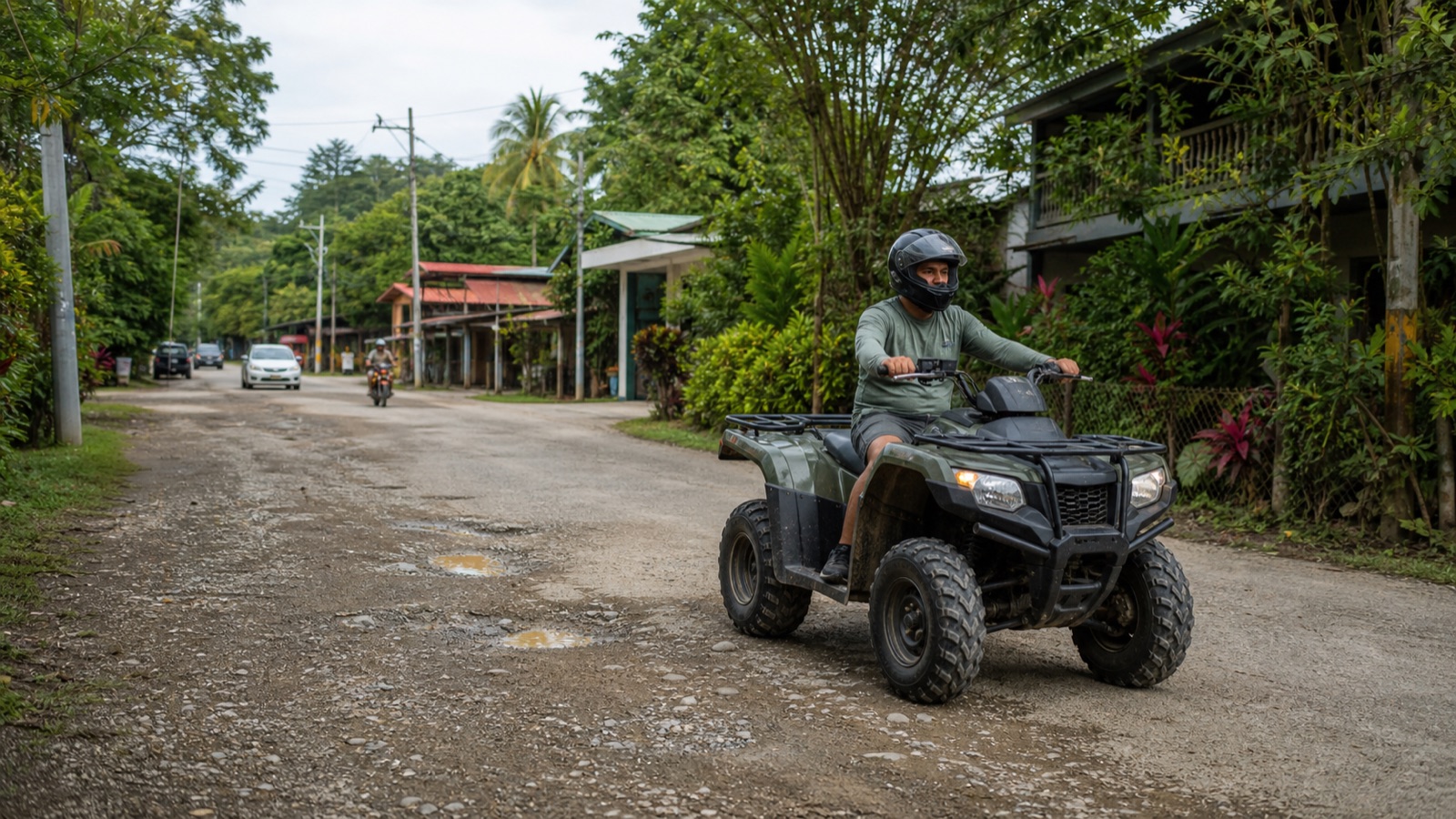
Santa Teresa's road is a shared transport corridor, not an off-road playground. Cars, deliveries, pedestrians, bicycles, e-bikes, motorcycles and ATVs use the same limited space. Drive slowly enough to stop for a hidden pothole, animal, pedestrian or vehicle entering from a side road.
Dry-season dust can reduce visibility and conceal loose stone. Rain fills depressions, reduces grip and changes drainage channels quickly. Slow before a hazard rather than making a sharp last-second input. Increase following distance and turn back when water depth or surface stability is uncertain.
A steep villa road can be more difficult coming down than going up. Ask about current condition, safe passing points and parking. Never assume that four wheels prevent rollover on a cross-slope, sharp turn or eroded edge.
- Use conservative speed and greater following distance.
- Avoid abrupt acceleration, steering or braking on loose surfaces.
- Keep all approved occupants within the designed seating and foot areas.
- Recheck the route after heavy rain.
- Do not follow map shortcuts onto unknown tracks.
- Plan to finish unfamiliar routes before dark.
Beaches, Private Roads and Prohibited Routes
Do not ride an ATV on the beach. Costa Rica's official tourism safety guidance explicitly states that four-wheelers are prohibited along beaches and heavily trafficked roads. Beach riding also threatens people, wildlife and sensitive coastal areas.
A path on a map is not proof of public access. Do not enter private property, trails, protected areas, rivers or closed roads without clear legal authorization and contractual permission. Ask the provider for current permitted-route guidance.
If directions conflict with signs, gates, local instructions or the contract, stop. A scenic photograph is not worth a fine, recovery bill, insurance exclusion or damage to the community's environment.
- No beach riding.
- No private land without explicit permission.
- No river crossing based on guesswork.
- No protected-area or closed-road entry.
- No route that the contract excludes.
Passengers, Surfboards and Cargo
Use only the passenger capacity stated for the exact model and approved by the provider. Passenger weight changes braking, steering and rollover dynamics. Both occupants need correctly fitted helmets and must keep hands and feet in the designed positions.
Some local operators advertise optional surf racks. Confirm supported board size, price, mounting, straps and whether a passenger remains permitted. Inspect mounts before every journey and stop if the board or rack moves. Never carry a board by hand.
Keep other cargo within approved racks or storage and below the stated limit. Do not stack bags where they block lights, controls or vision. For several suitcases, children or mobility equipment, use an appropriate car or transfer.
- Declare passenger and equipment before booking.
- Use provider-approved racks and straps only.
- Keep weight within the model's stated limits.
- Recheck mounts during longer trips.
- Switch to a car when cargo cannot be secured safely.
Fuel, Parking and Security
Photograph the fuel gauge and odometer at pickup. Ask which fuel the ATV uses, where to refuel and whether the return policy is full-to-full or another defined level. Do not wait until the last bar before searching for a station on a regional route.
Park only where the property or business allows it, without blocking traffic, entrances or pedestrians. Use the steering lock, key and any additional device supplied. Ask the accommodation for secure, lit overnight parking.
Do not leave passports, cash, electronics or luggage visible on the ATV. Keep the key with you and report loss or attempted theft immediately according to the contract.
- Fuel type and return level recorded.
- Nearest suitable fuel stop saved.
- Legal destination and overnight parking confirmed.
- Key and security devices used every time.
- Valuables removed from the vehicle.
Breakdowns, Accidents and Emergency Procedure
Save the rental operator's support number offline and ask for the covered hours and area. After a mechanical issue, stop in the safest reachable place, document the ATV and location, and wait for instructions. Do not authorize repairs or tow the vehicle without written approval.
For a collision, rollover, injury or immediate danger, call Costa Rica's emergency number 9-1-1. Follow the police, insurer and rental-company reporting sequence in the contract. Record the location, time, plates, people involved and witness details when safe.
Do not accept unsolicited roadside repair help or admit liability. Keep every case number, message and receipt. Failure to report correctly can affect insurance protection.
- People first: call 9-1-1 for injury or danger.
- Contact the operator using the saved emergency number.
- Document location, damage and involved vehicles.
- Follow police and insurer instructions.
- Obtain written approval before repair or recovery.
ATV Rental Booking Checklist
- Exact model, engine size, transmission and passenger capacity confirmed.
- Licence class, age and driver experience accepted in writing.
- Total price with tax, card fee, delivery and equipment stated.
- Daily or weekly unit and return time understood.
- Deposit amount and release process saved.
- Insurance, deductible and exclusions read.
- Permitted roads and geographic limits confirmed.
- Tires, brakes, lights, controls, racks and helmets inspected.
- Existing damage, fuel and odometer documented.
- Accommodation access and secure parking checked.
- Fuel, breakdown and recovery plan saved offline.
- Rain, darkness and alcohol fallback arranged.
ATV Rental Santa Teresa FAQ
How much does ATV rental cost in Santa Teresa?
Current public listings reviewed August 6, 2026 show roughly US$70 per day for some 250–300cc quads, US$80 for a Honda TRX 420 and US$90 for 450–520cc examples. Tax, season, payment method and rental length can change the total.
What deposit should I expect?
Several local fleet pages currently show a US$500 deposit for ATVs. Confirm the exact card hold, currency and release timing before booking.
Do I need a licence to drive an ATV?
Yes. Confirm that your original valid licence covers the exact quad and engine class in Costa Rica and that the operator accepts it. Do not assume a car-only licence is sufficient.
Can I drive an ATV on the beach?
No. Costa Rica's official tourism safety guidance says four-wheelers are prohibited along beaches. Stay on legal, permitted roads allowed by the rental contract.
Can two people ride one ATV?
Only if the exact model, law, licence and rental agreement permit it. Both need properly fitted helmets; never infer capacity from seat length alone.
Are helmets included?
Several local listings advertise two helmets, but verify quantity, fit and condition. Refuse damaged or badly fitting equipment.
Can an ATV carry a surfboard?
Some providers offer optional racks. Confirm board size, rack price, straps, passenger compatibility and contractual permission. Never carry a board by hand.
Is an ATV safe in rain?
Rain changes grip, visibility, potholes and drainage. An experienced driver may use a suitable ATV conservatively, but should postpone or change transport whenever conditions remove the safety margin.
Is an ATV better than Bimba?
It is better for some rough permitted access, continuous use and longer trips. Bimba can be simpler and cheaper for suitable short local rides at US$1 to unlock plus US$0.50 per minute or US$15 for 100 minutes.
Should I rent an ATV for the whole stay?
Only if repeated daily routes justify it. Compare a shorter ATV rental plus Bimba and taxis against the full weekly cost, fuel and unused days.
Sources and Final Local Recommendation
Prices and fleet details were reviewed August 6, 2026 using the public pages of ATValerios, Motorcycle Rentals Santa Teresa, Santa Teresa Adventure Rentals and Buggy Blue. Safety and route guidance is supported by Visit Costa Rica's Safety Passport and Traffic Law 9078.
Our recommendation is to rent the smallest suitable ATV only when its capability solves a verified access, distance or carrying requirement. Get licence acceptance and the all-in contract in writing, inspect the quad in daylight and keep a non-driving plan for alcohol, darkness or unsafe weather.
For compatible short journeys, check Bimba in the app. Compare wider choices in the Santa Teresa transportation guide and see when a protected vehicle wins in the e-bike versus car comparison.